

When your HVAC system finally gives out, the first question that pops into your head is almost always, "How much is this going to cost me?" The short answer is that a full HVAC replacement typically falls somewhere between $5,000 and $15,000. Most homeowners end up paying in the $11,590 to $14,100 range for a complete new system.
But that's a huge range, right? The final price tag really boils down to the type of system you need, the size of your house, and how energy-efficient you want to go.
Your Quick Guide to HVAC Replacement Costs
Trying to pin down the cost of an HVAC replacement can feel like solving a puzzle with half the pieces missing. You see numbers all over the place, but it's tough to know what's actually included or why prices vary so dramatically.
It helps to think of it like buying a car. The sticker price is just a starting point. Your final cost depends on the model, its gas mileage, any cool features you add, and even the dealership's reputation for great service. Your HVAC quote works the same way—it's not just for the furnace or AC unit. It's a whole package deal that covers the equipment, the skilled labor to install it, and any other tweaks needed to keep your home comfortable for the next 15 to 20 years.
This guide is your roadmap. We'll break down every part of your potential investment so you know exactly what you're paying for, starting with the baseline numbers.
National Averages and Benchmarks
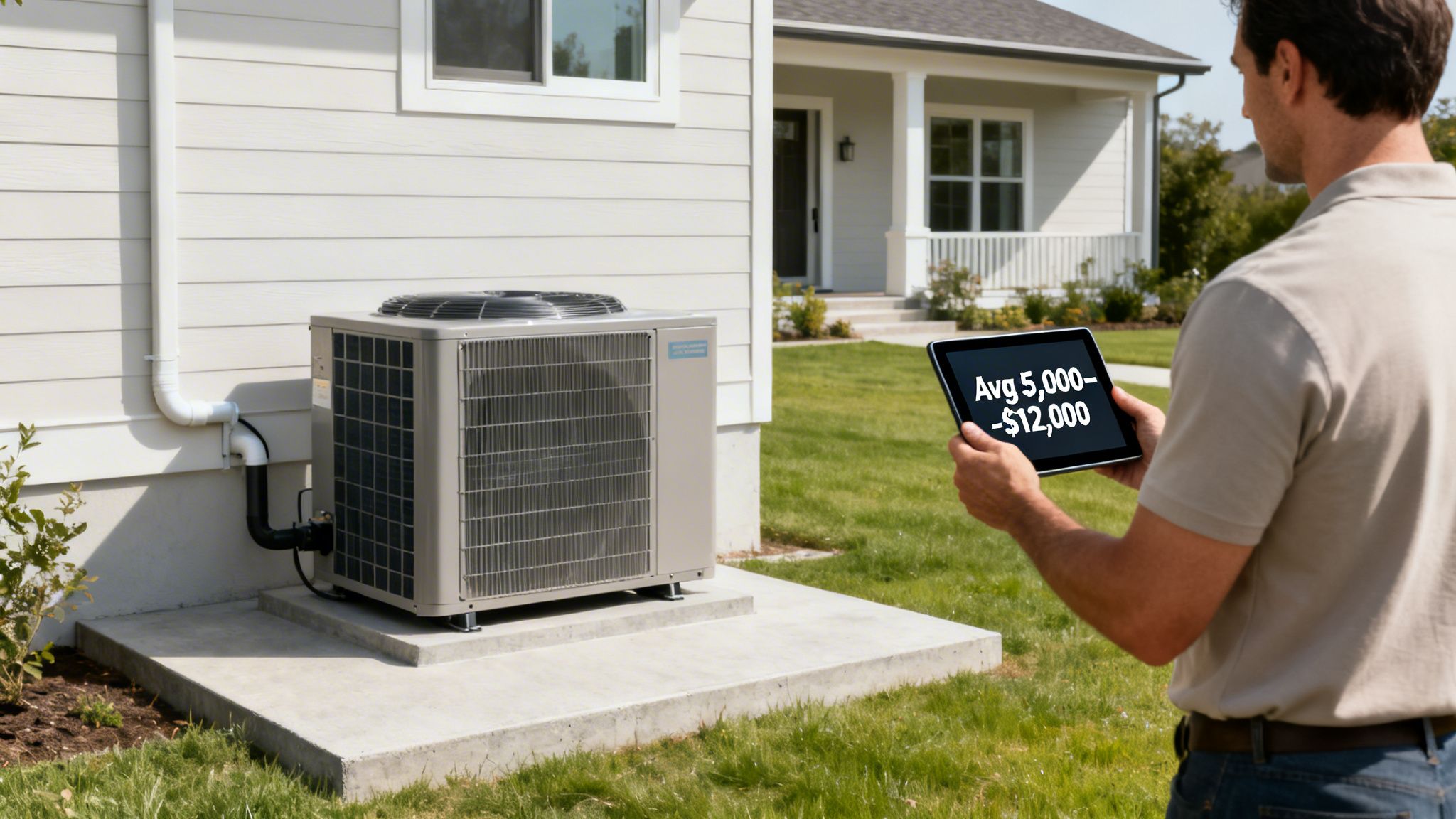
Let's ground this conversation with some real data. After looking at over 56,000 projects from actual homeowners, we found that the average cost to replace a full HVAC system in the U.S. is between $11,590 and $14,100. For a standard 2,000 to 2,500 square foot home, that price often lands around $13,430 for a new air conditioner and gas furnace combo. You can dig into more of these HVAC cost insights on Modernize.com.
A good rule of thumb that pros often use is to budget about $3 to $6 per square foot for a complete installation. So, if you have an 1,800 sq. ft. home, you’re likely looking at a range of $5,400 to $10,800, depending on the gear you choose and what labor costs look like in your area.
Key Takeaway: The national average is a great starting point, but your final cost will be unique. Things like the brand you pick, the system's efficiency (its SEER2 rating), and how complicated the installation is will all push that number up or down.
To give you an even clearer picture, let's break down the costs for different types of HVAC replacements.
HVAC Replacement Costs at a Glance
This table gives you a quick snapshot of what you can expect to pay for the most common HVAC replacement jobs in a typical 2,000 sq. ft. home.
Central AC Only $4,500 – $8,500 To replace an aging or broken air conditioner while keeping a functional furnace. Furnace Only $3,500 – $7,500 To upgrade an old heating system, common in regions with harsh winters. Heat Pump System $6,000 – $12,000 A single, all-electric unit for both heating and cooling, best for moderate climates. Full HVAC System $8,000 – $15,000+ A complete overhaul with a new AC and furnace, ensuring maximum efficiency.Think of these numbers as solid ballpark figures. They give you a realistic idea of the investment you’re looking at, whether you need to swap out just one component or are ready for a full system upgrade.
Decoding the Price Tag of Your New HVAC System
When you start collecting quotes for an HVAC replacement, it can be downright confusing to see prices that are thousands of dollars apart. Getting a handle on how much an HVAC replacement costs is a lot like looking at a detailed restaurant bill—there’s the main course, the service charge, and a few side dishes you might not have expected.
Each line item on a contractor’s proposal tells a story about where your money is going. Once you understand the key components, you can confidently compare offers and see the real value behind each price tag.
The Main Course: Your HVAC Equipment
The single biggest chunk of your bill—often 40% to 60% of the total—is the cost of the physical equipment itself. This isn't just one box; it's the outdoor condenser unit, the indoor air handler or furnace, and the evaporator coil working together. But not all equipment is created equal, and a few key things drive the price.
- System Size (Tonnage): In the world of HVAC, bigger isn't always better. Your unit's size, measured in tons, has to be a perfect match for your home's square footage, layout, and insulation. An oversized unit will constantly turn on and off, failing to properly dehumidify your home, while an undersized one will run nonstop without ever hitting the right temperature.
- Brand and Model Tier: Just like with cars, HVAC brands have different product tiers. Premium brands often come with a higher price tag but might include advanced features and better warranties. Even within a single brand, you’ll find entry-level, mid-range, and high-end models with different bells and whistles.
- Efficiency Ratings (SEER2, AFUE, HSPF2): This is a huge one. A unit with a higher SEER2 (Seasonal Energy Efficiency Ratio 2) for cooling or AFUE (Annual Fuel Utilization Efficiency) for heating will cost more upfront. But that initial investment pays you back month after month with lower energy bills.
Think of a high-efficiency unit like a hybrid car. You pay more at the dealership, but you save money at the pump for years to come.
The Service Charge: Labor and Installation Complexity
Right behind the equipment, labor is the next biggest expense, typically making up 20% to 50% of the final invoice. This isn’t just about the time a technician spends in your home; it’s about the skill, training, and overhead required to get the job done right.
An expert installation is the single most important factor in determining your new system's performance and lifespan. A top-of-the-line unit installed poorly will perform worse than a basic model installed by a master technician.
The complexity of your specific installation also plays a big role. A simple swap-out in an easily accessible basement will cost less than a tricky installation in a cramped attic or crawlspace. If the job requires new wiring, refrigerant lines, or pouring a new concrete pad for the outdoor unit, those tasks will add both time and material costs.
The Side Dishes: Ductwork, Permits, and Upgrades
Finally, a few other essential items contribute to the total cost. These aren't just add-ons; they're critical for a safe, legal, and effective installation.
- Ductwork Modifications: If your existing ducts are leaky, undersized, or just in bad shape, they may need to be repaired or even replaced. This can add $1,500 to $5,000 or more to the project, but it’s absolutely vital for efficiency. Installing a brand-new, high-performance system on leaky ducts is like trying to fill a bucket full of holes.
- Permits and Inspections: Most cities and counties require a permit for an HVAC replacement to make sure the work meets local safety codes. Permit fees usually run from $50 to $250, and the cost of the final inspection is often rolled into this.
- Smart Thermostats and Zoning: Upgrading to a smart thermostat might add $200 to $500 to the initial cost, but it can also shave 10% to 15% off your energy bills. A more complex zoning system, which lets you control the temperature in different areas of your house independently, will be a more significant investment.
To give you a clearer picture, let's break down how these factors contribute to your final bill.
Itemized Breakdown of HVAC Cost Factors
HVAC Equipment $3,000 – $8,000+ This is the heart of your system. Costs vary based on brand, size (tonnage), and efficiency ratings like SEER2 and AFUE. Labor & Installation $2,500 – $6,000+ This covers the skilled work of licensed technicians. Complex jobs in attics or crawlspaces will cost more than simple swaps. Ductwork Modification $1,500 – $5,000+ Leaky or undersized ducts cripple efficiency. Repairs or replacements are crucial for your new system to perform well. Permits & Fees $50 – $250 This ensures your installation is up to local safety codes, protecting your home and family. It's a small but necessary cost. Additional Upgrades $200 – $2,000+ This includes options like smart thermostats, whole-home humidifiers, or advanced air filtration systems that enhance comfort and control.By understanding these core components, you’re no longer just looking at a single number on a quote. You're analyzing a complete package, which empowers you to ask the right questions and choose the contractor who provides the most value for your home.
Comparing Costs for Different HVAC System Types
Choosing a new HVAC system is a lot like shopping for a car. Are you looking for the reliable family sedan that gets the job done, the ultra-efficient hybrid for long-term savings, or something specialized for a unique situation? Each option comes with a different price tag and is built for a specific purpose.
The key to getting this right is understanding how the costs vary between these system types. This isn't just about finding the cheapest unit, but about matching the right equipment to your home, climate, and budget to get the most value for your investment.
Central Air Conditioner and Furnace Combo
Think of this as the classic, all-American setup. An outdoor AC unit handles the cooling, while an indoor furnace—usually running on natural gas—provides the heat. It’s the most common system in North America for a reason: it delivers powerful, reliable performance for homes that already have ductwork.
- Average Installed Cost: $8,000 – $15,000 for a full replacement of both units.
- Best For: Homes in regions with distinct hot summers and cold winters. It's the go-to for homeowners who already have ducts in place and want a straightforward, effective solution.
- Pros & Cons: These systems are incredibly effective and familiar to nearly every technician, so service is easy to find. The main drawback is the upfront cost of replacing both components, and of course, a gas furnace won't work for homes without a natural gas line.
All-Electric Heat Pump Systems
A heat pump is the clever, two-in-one workhorse of the HVAC world. Instead of creating heat, it just moves it around. In the summer, it pulls heat out of your home to cool it. In the winter, it reverses the process, grabbing ambient heat from the outside air and bringing it inside.
This slick process makes it a fantastic choice for efficiency, especially in moderate climates where winters don't drop into a deep freeze for long stretches.
- Average Installed Cost: $6,000 – $12,000 for a complete system.
- Best For: Homeowners in mild to moderate climates who want a single, highly efficient unit for both heating and cooling. They're also an excellent way to move away from fossil fuels.
- Pros & Cons: Heat pumps are incredibly energy-efficient, which can lead to some serious savings on your utility bills. On the flip side, their heating performance can start to lag in sub-freezing weather, sometimes requiring a supplemental heat source to keep up.
Expert Insight: For colder climates, a "dual-fuel" system is a popular solution. It combines an electric heat pump with a gas furnace. The heat pump handles most of the year, but the furnace automatically kicks in during those deep freezes, giving you the best of both worlds: incredible efficiency and powerful heating.
So, where does all that money go? This chart breaks down the typical costs for a standard replacement project.
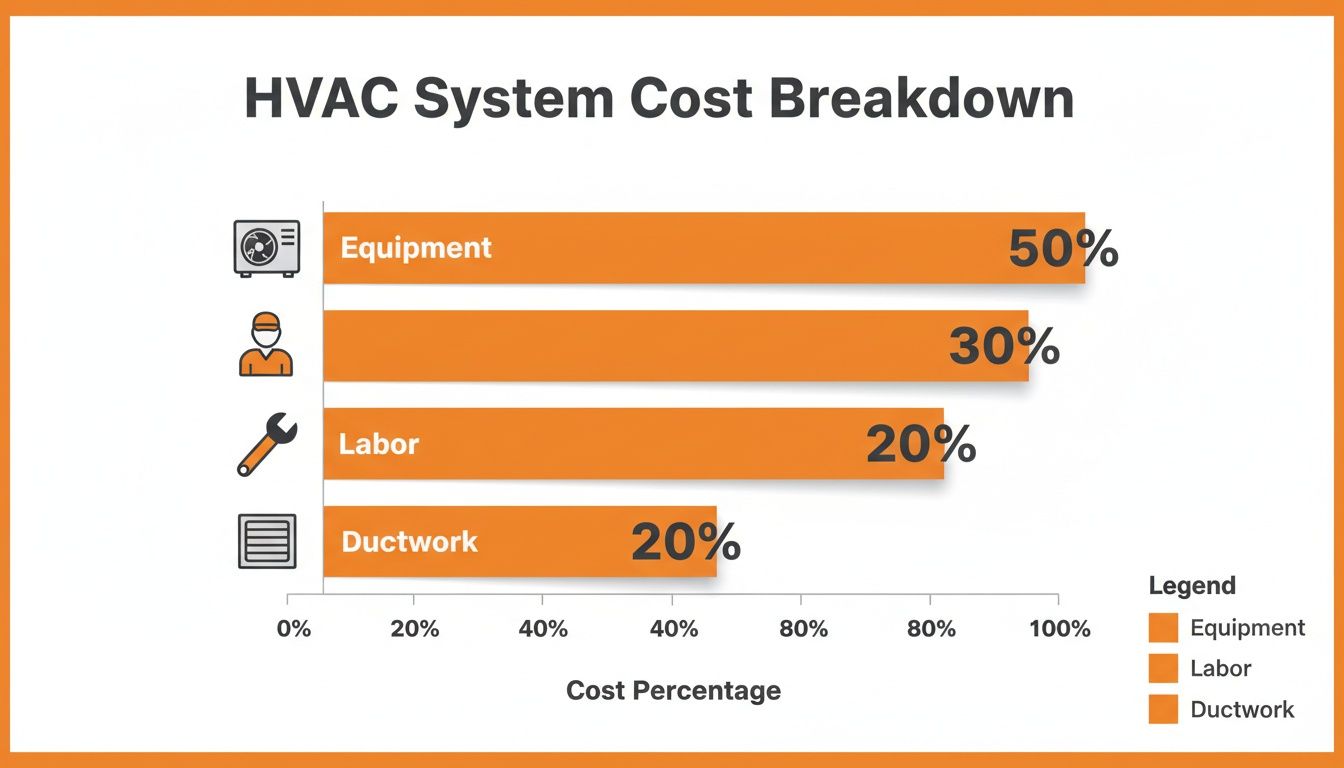
As you can see, the equipment itself is the biggest piece of the pie, but don't underestimate the cost of skilled labor and any ductwork modifications needed to get the job done right.
Ductless Mini-Split Systems
What if your home doesn't have ducts? Or maybe you just want to cool a new addition or a stubborn hot spot like a sunroom? The ductless mini-split is your answer. These systems use an outdoor compressor connected to one or more indoor air handlers mounted discreetly on a wall or ceiling.
Each indoor unit can be controlled on its own, giving you precise, room-by-room temperature control. This "zoning" capability makes them both incredibly versatile and highly efficient.
- Average Installed Cost: $4,500 – $12,000, depending on how many indoor zones you need.
- Best For: Homes without existing ductwork, new additions, converted garages, or for anyone who wants to create different temperature zones in their house.
- Pros & Cons: The big advantages are flexibility and efficiency—you aren't wasting energy cooling empty rooms. The main drawback is the upfront cost, which can get higher than a central system if you need to install several indoor units.
A closer look at pricing shows a clear hierarchy. Central AC split systems, for example, average $6,500 to $12,500 total, while more advanced dual-fuel combos can climb to $10,500 to $15,000. At the top end, premium geothermal systems often run $18,000 to $30,000+. To see how these numbers stack up in different parts of the country, you can get more details from Green Leaf Air's cost analysis. This kind of data helps set realistic expectations before you start gathering quotes for your own project.
Why HVAC Replacement Prices Are Rising
If you've gotten a quote for a new system recently, you might be feeling a bit of sticker shock. You're not alone. The numbers on those proposals aren't pulled out of thin air; they're the result of a perfect storm of economic factors hitting the entire industry. Knowing what’s behind these rising costs helps you see the true value in a quality installation—and the potential cost of putting it off.
It’s a lot like the price of gas or groceries. When it costs more to produce, ship, and sell those items, the price you pay at the register goes up. The same thing is happening behind the scenes in the world of heating and air conditioning, and it all trickles down to the final quote you receive.
The Rising Cost of Raw Materials
At its heart, an HVAC system is just a sophisticated box of metals, plastics, and electronics. Key materials like copper for refrigerant lines, steel for the cabinets, and aluminum for the coils have all seen wild price swings lately.
Ongoing inflation and global supply chain headaches have made these core materials much more expensive for manufacturers to get their hands on. Those costs get passed from the factory to the distributor, then to your local contractor, and finally, into the total price of your new unit. It's the most basic reason why the same system costs more today than it did just a year or two ago.
The Big Picture: Rising material costs are a huge factor. They create the baseline for price hikes on every single unit that rolls off the assembly line, making it more important than ever for homeowners to budget realistically for a replacement.
New Efficiency Standards and Technology
The government is also playing a part in this. New federal regulations now require all new residential HVAC systems to meet much higher minimum energy efficiency standards. These new rules, known as SEER2 (Seasonal Energy Efficiency Ratio 2), have forced manufacturers to build more advanced and effective equipment.
This is fantastic news for your future energy bills, but it does mean a higher price tag upfront. To meet these tougher standards, manufacturers have poured money into R&D, retooling their factories to build units with high-tech components like variable-speed compressors and smarter control boards. All that innovation adds directly to the initial cost of a new system.
A Nationwide Skilled Labor Shortage
Another major force pushing up the how much does hvac replacement cost is a stubborn, industry-wide shortage of skilled technicians. For years, the demand for qualified, experienced HVAC pros has been growing faster than the supply. This imbalance means good contractors have to offer better pay and benefits to attract and keep top talent.
That higher labor cost shows up directly in installation rates. In high-demand areas, experts have seen technicians raise their installation prices by 10% to 15% just to keep up. This is part of a larger trend predicting a $1,000 to $1,200 year-over-year jump from median HVAC replacement prices, driven by labor shortages, new EPA rules, and material costs. In the first quarter of this year alone, major manufacturers like Centrotherm and Crown Engineering announced price increases of 6% and 5%. You can dive deeper into these industry-wide pricing trends on YouTube.
When you put it all together—pricier materials, smarter technology, and a tight labor market—you get an environment where costs are on a steady upward climb. It’s a reality that underscores the hidden cost of waiting, as a quote for the same job will almost certainly be higher next year than it is today.
How to Get an Accurate and Fair HVAC Quote
Getting the right quote is the single most important part of keeping your HVAC replacement costs in check. Think of it this way: a vague, one-line estimate is a huge red flag. What you're looking for is a detailed, itemized quote from a professional who is confident in their work and transparent about their pricing.
You wouldn’t hire a builder for a home renovation based on a single number scribbled on a napkin, right? You’d want a full blueprint laying out the cost of materials, labor, and a clear timeline. Your HVAC quote deserves that same level of detail. It’s the only way to make sure you get a fair price for quality work that will last.
Prepare for the On-Site Evaluation
You can actually do a little prep work before a contractor even steps through your door. Having this information ready helps them dial in their assessment right from the start.
- Home Details: Know your home's approximate square footage and the year it was built.
- Current System: Jot down the brand, model, and age of your existing furnace and air conditioner. You can usually find this on a sticker on the side of the unit.
- Problem Areas: Make a quick list of any comfort issues you’ve noticed, like that one bedroom that’s always freezing or the living room that gets stuffy in the summer.
Any contractor worth their salt will insist on an on-site visit. They need to see your home’s layout with their own eyes, inspect the condition of your existing ductwork, and check the electrical panel. Most importantly, they need to perform a Manual J load calculation, which is the industry-standard method for figuring out the exact size of the system your home needs.
Crucial Step: A load calculation is absolutely non-negotiable. If a contractor just glances at your old unit and says, "We'll just put in another one the same size," they're taking a massive shortcut. This lazy approach can lead to an oversized or undersized system, which means years of poor performance and sky-high energy bills.
The Power of Multiple Itemized Quotes
Here's the golden rule: never, ever accept the first quote you get. You should aim to get at least three written, itemized quotes from different licensed and insured contractors. It’s the only way to get a true feel for the market rate in your area and compare what you’re being offered.
An itemized quote is your best friend here. It should clearly break down the major costs: the price of the equipment, the cost of labor, any needed ductwork modifications, and the fees for permits. This transparency protects you from surprise charges and lets you see exactly what you’re paying for, making an apples-to-apples comparison easy.
Essential Questions to Ask Every Contractor
Once you have a few quotes in hand, it’s time to dig a little deeper. Asking the right questions helps you vet the contractor and feel confident you’re hiring the right team for the job.
- Licensing and Insurance: "Can you provide proof of your state license and liability insurance?" This is your safety net, protecting you in case of accidents or property damage.
- Specific Equipment Models: "Which exact model numbers for the furnace, coil, and condenser are you quoting?" This lets you research the specific equipment yourself and look up its efficiency ratings and reviews.
- Warranty Details: "What are the manufacturer's warranties on parts and the compressor? And what is your personal labor warranty for the installation?"
- Timeline and Team: "How long will the installation take, and will your own employees be doing the work, or do you use subcontractors?"
- Permits and Inspections: "Does your quote include pulling all the necessary local permits and arranging for the final inspection?" You don't want to be on the hook for this.
By taking these steps, you shift from being a passive price-taker to an empowered, informed homeowner. You’ll be fully equipped to choose a contractor who offers fair pricing and a top-notch installation, making sure your investment pays off for years to come.
Smart Strategies to Lower Your HVAC Replacement Cost
Let's be honest, a new HVAC system is a major investment. But the final price tag isn't set in stone. With a little strategic thinking, you can find plenty of opportunities to bring that total cost down without cutting corners on quality or comfort.
Think of it like booking a vacation. You wouldn't just pay the first price you see, right? You'd look for off-season deals or use loyalty points to save some cash. The same logic applies here. By being smart about when you buy, what incentives you use, and the equipment you choose, you can make this home upgrade far more affordable.
Time Your Purchase Wisely
Timing is everything. HVAC contractors are swamped during the peak of summer and the dead of winter. That’s when emergency calls are flooding in, demand is high, and prices follow suit. You'll likely face higher quotes and longer waits.
You can flip this to your advantage by planning your replacement during the industry’s “shoulder seasons”—that sweet spot in spring and fall. During these milder months, contractors have more breathing room in their schedules and are often willing to offer more competitive pricing to keep their crews busy.
Tap into Rebates and Tax Credits
Never, ever pay the sticker price without hunting for incentives first. The government and your local utility company want you to install energy-efficient equipment, and they're willing to give you money to do it. These programs can take a serious chunk out of your out-of-pocket cost.
Federal Tax Credits: High-efficiency heat pumps, furnaces, and air conditioners that meet certain criteria can qualify you for federal tax credits. This could mean a savings of up to $2,000 or more on your next tax return.
Local Utility Rebates: Most local power and gas companies offer direct cash rebates for installing newer, energy-saving models. These can range anywhere from a few hundred to over a thousand dollars, depending on where you live and the system you pick.
A savvy homeowner can often "stack" these incentives. Imagine combining a federal tax credit with a rebate from your local utility—you could easily slash thousands off the final how much does hvac replacement cost. Suddenly, that top-tier, high-efficiency system looks like a brilliant long-term investment.
Prioritize Right-Sizing Over Raw Power
It’s a common myth that a bigger, more powerful HVAC system is always the better choice. In reality, an oversized unit is both inefficient and ineffective. It will blast your home with hot or cold air too quickly, leading to short, frequent cycles. This choppy performance fails to properly dehumidify the air, leaving you feeling sticky and uncomfortable.
A professional contractor should always perform a Manual J load calculation before giving you a quote. This isn't just a quick glance at your square footage; it's a detailed analysis of your home's insulation, windows, layout, and local climate. Getting this calculation right ensures you don't overpay for a unit that's too big or suffer with one that's too small. It's the absolute key to balancing comfort and efficiency.
Still Have Questions? Let's Clear Things Up
Even with all the numbers laid out, you probably have a few practical questions swimming around in your head before pulling the trigger. It's completely normal. Let's tackle some of the most common things homeowners ask right before making a final decision.
Is It Cheaper to Replace My Furnace and AC at the Same Time?
Yes, almost always. Think of it this way: when you replace both at once, you're paying for a single, streamlined job instead of two separate ones. The technician only has to open up your system, connect everything, and test it one time, which saves a huge amount on labor.
Beyond the initial savings, this approach ensures your new furnace and air conditioner are perfectly matched. A matched system works together like a well-oiled machine, achieving peak efficiency that will lower your energy bills for years to come. Many contractors even offer "bundle" pricing for a full system replacement, which can save you even more.
How Long Does a Typical HVAC Replacement Take?
For a straightforward swap—where the old unit comes out and the new one goes in without much fuss—you can expect the job to take one full day. A professional crew can typically get it all done in about 8 to 10 hours.
However, life isn't always that simple. If the project requires major ductwork changes, electrical upgrades, or wrestling a new unit into a cramped attic or crawlspace, the work might stretch into two or even three days. Your contractor should always give you a clear, realistic timeline with your official quote so you know exactly what to expect.
The 5,000 Rule: A Quick Gut Check for Repair vs. Replace Here’s a handy rule of thumb many in the industry use: Multiply the age of your system (in years) by the estimated repair cost. If that number is over $5,000, it’s a strong sign that replacement is the smarter financial move in the long run.
Does a New HVAC System Actually Increase My Home Value?
Absolutely. A brand-new, high-efficiency HVAC system is a huge selling point for potential buyers. It screams "this home is well-maintained" and gives them peace of mind, knowing they won't be slapped with a massive replacement bill right after moving in.
Real estate pros and renovation experts agree: homeowners can often recoup 50% to 70% of what they spend on a new system when they sell their home. It's a tangible, practical upgrade that signals modern comfort and lower energy bills, making your property stand out from the competition.
Finding a qualified, trustworthy professional is the most important step in your HVAC replacement journey. AirCon Heat connects you with top-rated, licensed, and insured local contractors in over 1,000 cities. Get free, no-obligation quotes from the best pros in your area by visiting https://airconheat.com.